




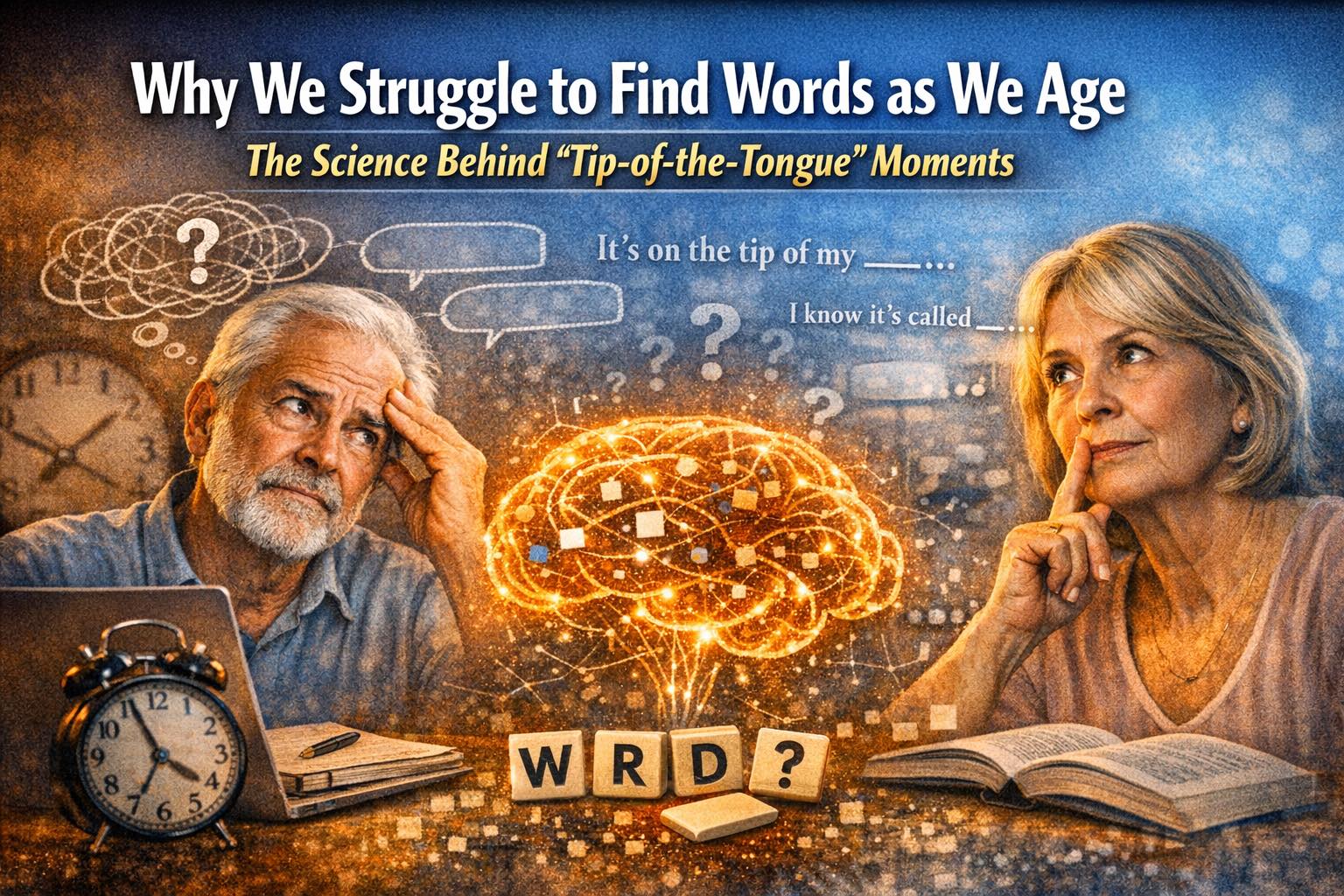
If you’ve ever paused mid-sentence trying to remember a word that’s “right there,” you’re not alone. Word-finding difficulty – those frustrating “tip-of-the-tongue” moments – becomes more common as we age. A new study published in Aging, Neuropsychology, and Cognition by researchers at the University of Toronto and Baycrest Hospital sheds light on why this happens and what it reveals about how our brains change over time.
The study, titled “Cognitive Components of Aging-Related Increase in Word-Finding Difficulty” (DOI: 10.1080/13825585.2024.2315774), examined how different cognitive processes contribute to the growing challenge of retrieving words as we get older. The findings suggest that slower processing speed – rather than memory loss or language decay – may be the main reason older adults struggle to find words.
What the Researchers Did
The team, led by Dr. Hsi T. Wei and colleagues, studied 125 healthy adults aged 18 to 85 using an online “covert naming” task. Participants saw pictures and had to silently name them while dealing with distractions designed to mimic real-life conversation challenges. The researchers measured reaction times, accuracy, and interference effects, then compared these results with natural speech samples and executive function tests.
They tested three major theories of word-finding difficulty:
- Processing Speed Theory – Suggests that aging slows down all mental operations, making it harder to retrieve words quickly.
- Inhibitory Deficit Hypothesis – Proposes that older adults struggle to ignore irrelevant information, which clutters mental retrieval.
- Transmission Deficit Hypothesis – Focuses on weakened connections between word meanings and their sounds, making it harder to recall specific words.
What They Found
The results supported the Transmission Deficit Hypothesis and the Processing Speed Theory more strongly than the inhibitory deficit idea. In simple terms, the study found that:
- Semantic interference (confusion between similar meanings) increased with age.
- Phonological facilitation (help from similar-sounding words) decreased.
- Overall reaction time for word retrieval was the best predictor of spontaneous word-finding difficulty.
- Executive function decline correlated with slower verbal reaction times, not with memory loss.
This means that older adults don’t necessarily forget words – their brains just take longer to find them. The slowdown affects how quickly the brain can connect meaning, sound, and speech.
Why This Matters
Word-finding difficulty is one of the most common cognitive complaints among older adults. It can cause embarrassment, frustration, and even anxiety in social situations. But this study shows that these lapses are not necessarily signs of dementia or serious cognitive decline.
Instead, they reflect normal changes in how the brain processes information. As Dr. Wei explains, “Our findings suggest that word-finding difficulty is more about speed than loss. The connections are still there – they just take longer to activate.”
Everyday Examples
You might notice this when:
- You can describe an object perfectly but can’t recall its name.
- You mix up similar words (“microwave” instead of “oven”).
- You pause mid-sentence searching for a familiar term.
These moments are part of normal aging, not necessarily a warning sign of disease. The study found that even younger adults experience occasional word-finding difficulty, though it becomes more frequent with age.
How to Keep Your Word-Finding Skills Sharp
While we can’t stop the clock, there are ways to support healthy language function and processing speed:
1. Stay mentally active. Reading, writing, and learning new skills keep neural connections strong.
2. Exercise regularly. Physical activity improves blood flow to the brain and supports cognitive speed.
3. Get enough sleep. Rest helps consolidate memory and language pathways.
4. Practice mindfulness. Reducing stress can improve focus and retrieval.
5. Engage socially. Conversations challenge the brain to retrieve words quickly and accurately.
Researchers also suggest that speech-based games and naming exercises may help maintain verbal agility.
The Bigger Picture
This study adds to a growing body of research showing that cognitive aging is not just about memory loss – it’s about processing efficiency. The brain remains capable but works more slowly, especially when juggling multiple pieces of information.
The findings could help clinicians distinguish between normal aging and early signs of neurodegenerative disease. For example, if someone’s word-finding difficulty is accompanied by confusion, disorientation, or personality changes, that may warrant further evaluation. But isolated “tip-of-the-tongue” moments are usually benign.
Key Takeaways
| Concept | Explanation |
| Word-finding difficulty | Common with age, not necessarily memory loss |
| Main cause | Slower processing speed |
| Brain mechanism | Weakened connections between meaning and sound |
| Diagnostic value | Helps differentiate normal aging from disease |
| Prevention | Mental activity, exercise, sleep, and social engagement |
Why This Research Stands Out
Previous studies often blamed word-finding difficulty on memory decline or language deterioration. This new research shifts the focus to processing speed, offering a more hopeful perspective. It suggests that maintaining overall brain health – through lifestyle and cognitive engagement – can help preserve language function.
The study also highlights the value of reaction time as a potential clinical measure. Tracking how quickly someone retrieves words could become a useful tool for assessing cognitive health in aging populations.
Onwards
For most people, forgetting words occasionally is a normal part of life. As we age, our brains take a little longer to connect the dots between thought and speech. The University of Toronto study reminds us that these changes are not failures – they’re part of the natural rhythm of cognitive aging.
So the next time you pause mid-sentence searching for the right word, take a breath. Your brain is still working beautifully – just at a slightly slower tempo.
Better Treatment, Lower Cost – No Catch.
Find safer, more effective medications with fewer side effects – often for less money. It’s fast, free, and personalized. Learn More →
Sources (3)
- Wei, H. T., Kulzhabayeva, D., Erceg, L., Robin, J., Hue, Y. Z., Chignell, M., & Meltzer, J. A. (2024). Cognitive components of aging-related increase in word-finding difficulty. Aging, Neuropsychology, and Cognition.
https://www.tandfonline.com/doi/full/10.1080/13825585.2024.2315774 - Baycrest Health Sciences. Cognitive Aging Research and Brain Health. https://baycrestfoundation.org/Brain-Matters/
- National Institute on Aging. How Aging Affects the Brain.
https://www.nia.nih.gov/health/brain-health/how-aging-brain-affects-thinking