




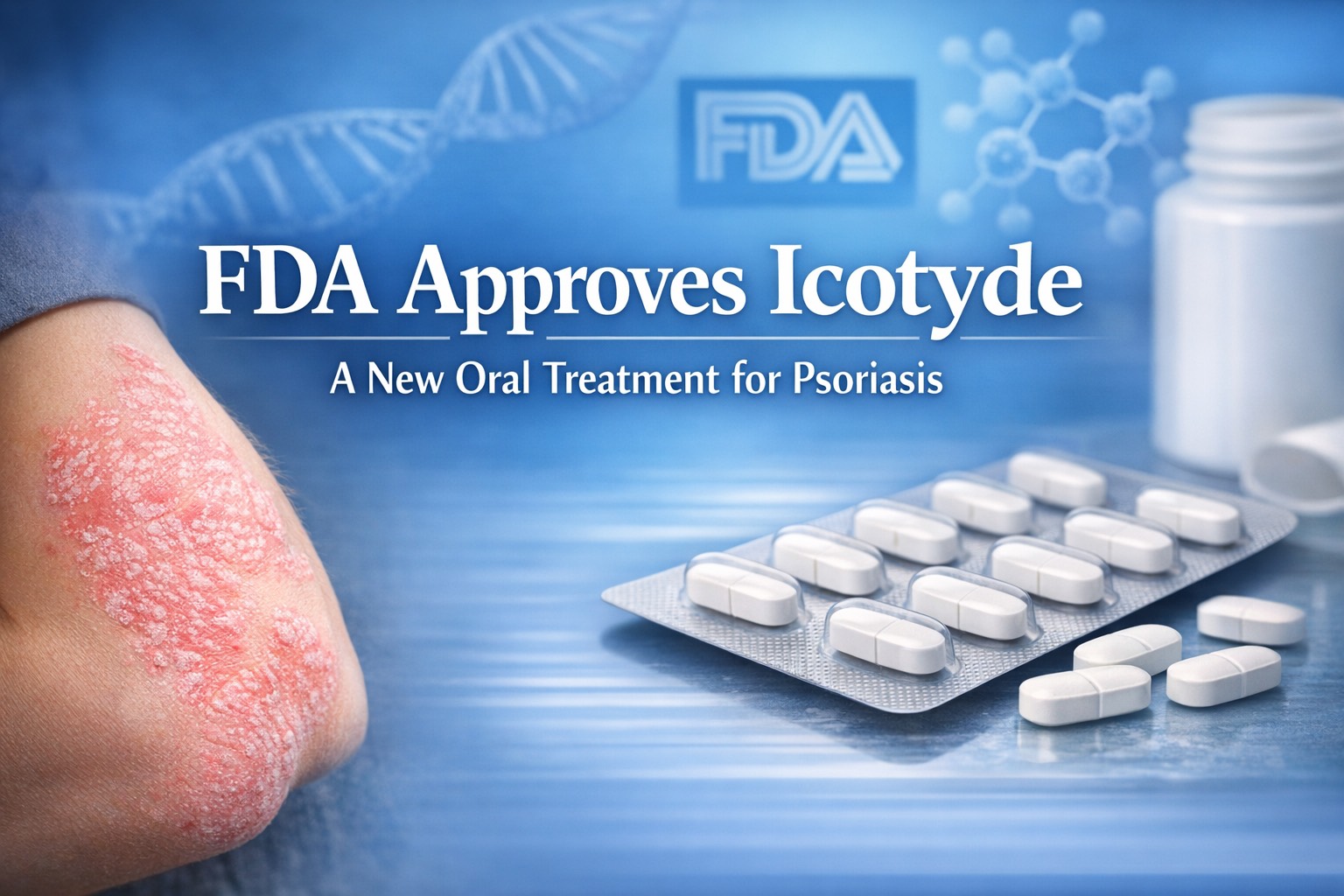
The U.S. Food and Drug Administration has approved Icotyde (icotrokinra) for the treatment of moderate-to-severe plaque psoriasis in adults and in adolescents 12 years and older who weigh at least 40 kg. This is notable because Icotyde is an oral, once-daily medication that targets the IL‑23 receptor, a key part of the immune pathway that drives many cases of plaque psoriasis.
If you or someone you care for has been struggling with persistent plaques, frequent flares, or the hassle of injections, this approval could change how treatment is approached. Below is a clear, practical breakdown of what Icotyde is, how it performed in trials, how it compares to other options, and what to watch for next.
What is Icotyde and how does it work?
Icotyde is a small peptide drug taken as a pill once a day. It works by blocking the interleukin‑23 receptor (IL‑23R) on immune cells. IL‑23 is a signaling protein that helps drive inflammation in psoriasis; by stopping the receptor, Icotyde reduces the inflammatory signals that cause skin cells to grow too quickly and form plaques.
The important point for most people: Icotyde aims to give the benefits of modern biologic therapies (strong, targeted control of psoriasis) in an oral form rather than an injection or infusion.
How well did Icotyde work in clinical trials?
The FDA approval was based on a large clinical program that included about 2,500 patients across multiple Phase 3 studies. In head‑to‑head trials against an active comparator, roughly 70% of patients reached “clear or almost clear” skin by investigator assessment (IGA 0/1) and about 55% achieved a PASI 90 response (meaning a 90% improvement in the Psoriasis Area and Severity Index) by Week 16. These are strong results for a pill.
Safety data showed that rates of adverse reactions in Icotyde‑treated patients were very close to placebo through Week 16, and no new safety signals were identified through one year of follow‑up in the trials. That said, every medicine has potential side effects, and long‑term real‑world experience will add more clarity.
Quick comparison: Icotyde versus common psoriasis treatments
| Feature | Icotyde (oral pill) | Injectable biologics (IL‑23/IL‑17 inhibitors) | Topical creams/ointments |
| How given | Once‑daily oral tablet | Injection (varies: weekly to every few months) | Applied to skin |
| Target | IL‑23 receptor | IL‑23 or IL‑17 pathway proteins | Local skin inflammation |
| Typical speed of effect | Rapid (weeks) | Rapid to moderate (weeks) | Slower; limited for widespread disease |
| Efficacy in trials | ~55% PASI 90 at Week 16 in head‑to‑head studies | Many biologics show high PASI 90 rates; varies by drug | Useful for mild disease only |
| Convenience | High (pill) | Lower (injections/clinic visits) | High for mild/localized disease |
| Safety monitoring | Routine checks recommended | Routine checks recommended | Minimal systemic monitoring |
This table simplifies complex data, but it highlights the main tradeoffs: convenience (oral pill) versus the well‑established track record of injectable biologics. The approval positions Icotyde as an option for people who need systemic therapy but prefer a pill.
Who might be a candidate for Icotyde?
The FDA label specifies adults and adolescents 12 years and older who weigh at least 40 kg and are candidates for systemic therapy or phototherapy. In plain terms, that means people whose psoriasis is moderate to severe, or whose disease affects quality of life enough that topical creams aren’t enough. Your dermatologist will consider factors such as how much skin is affected, whether joints are involved, prior treatments, other health conditions, and personal preferences.
Safety and monitoring – what to expect
Clinical trials reported that adverse reaction rates for Icotyde were similar to placebo through the early weeks of treatment, and no new safety signals were seen through one year. Still, standard practice with systemic psoriasis drugs includes baseline health checks and periodic monitoring (for example, screening for infections, liver tests, or other labs as recommended by your doctor). If you have a history of infections, immune problems, or other chronic conditions, discuss these with your clinician before starting any systemic therapy.
Practical things patients often ask
- Will insurance cover it? Coverage depends on your plan, prior treatments, and whether the insurer requires step therapy (trying other options first). Expect prior authorization processes for new, branded systemic drugs.
- How fast will my skin improve? Trial data show meaningful improvement by Week 16 for many patients, with some seeing benefits earlier. Individual responses vary.
- Is it safe for teens? The approval includes adolescents 12 and older who meet the weight requirement, based on the clinical program that included younger patients. Your child’s dermatologist can explain risks and benefits for a teen.
Why this approval matters
There are three practical reasons this is a big deal:
- Oral convenience – Many effective psoriasis drugs are injectables; a once‑daily pill is easier for many people to take and may improve adherence.
- Targeted approach – Blocking IL‑23 signaling is a proven strategy in psoriasis; Icotyde brings that mechanism into an oral format.
- More choices – More treatment options mean doctors and patients can tailor therapy to lifestyle, preferences, and medical history.
What to watch next
- Real‑world safety and effectiveness: Clinical trials are controlled environments; post‑approval use across broader populations will reveal more about long‑term safety and how well the drug works outside trials.
- Cost and access: Pricing, insurance coverage, and patient assistance programs will determine how widely Icotyde is used.
- Head‑to‑head comparisons over time: As more data accumulate, clinicians will better understand where Icotyde fits relative to established biologics.
Takeaway
Icotyde’s FDA approval introduces a targeted oral option for people with moderate‑to‑severe plaque psoriasis, backed by large clinical trials showing meaningful skin clearance and a safety profile similar to placebo in the short term. For many patients, the convenience of a once‑daily pill plus strong efficacy could be a welcome change – but decisions about starting any systemic therapy should be made with a dermatologist who can weigh benefits, risks, monitoring needs, and insurance considerations.
Better Treatment, Lower Cost – No Catch.
Find safer, more effective medications with fewer side effects – often for less money. It’s fast, free, and personalized. Learn More →
Sources (1)
- Johnson & Johnson press release: FDA approval of ICOTYDE (icotrokinra) ushers in new era for first‑line systemic treatment of plaque psoriasis.
https://www.jnj.com/media-center/press-releases/fda-approval-of-icotyde-icotrokinra-ushers-in-new-era-for-first-line-systemic-treatment-of-plaque-psoriasis-with-a-targeted-oral-peptide