




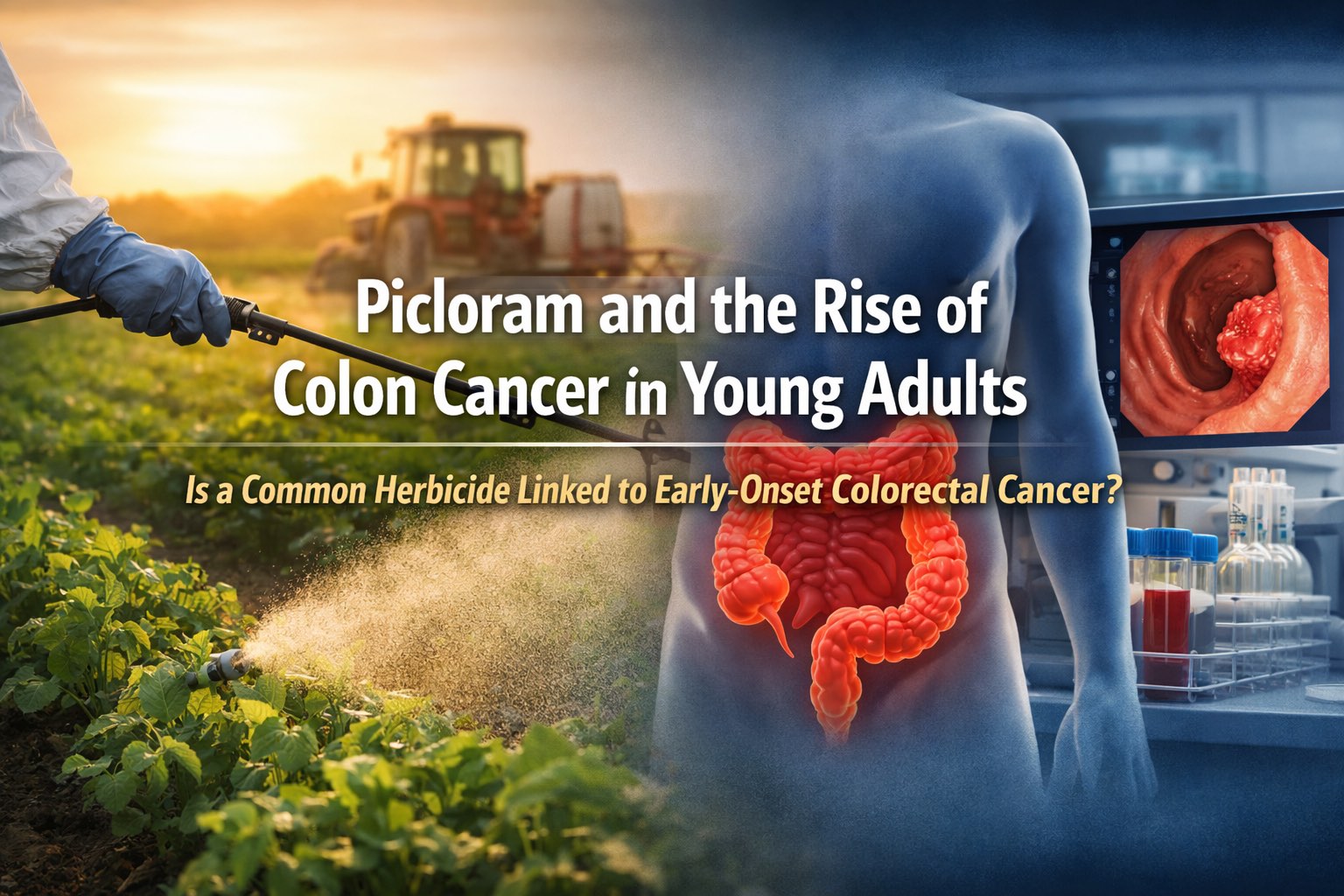
Colon cancer has long been considered a disease of older age. For decades, most cases were diagnosed in people over 50, and screening guidelines were built around that assumption. But over the past 20 years, something unsettling has been happening. Colon and rectal cancer rates have been climbing steadily among younger adults, including people in their 20s, 30s, and 40s. Doctors and researchers have struggled to explain why.
A new study published in Nature Medicine offers a possible piece of the puzzle. Researchers found a strong link between exposure to picloram, a widely used weed killer, and early-onset colorectal cancer. While the study does not prove that picloram causes cancer, it raises serious questions about how long-term exposure to certain chemicals may be affecting younger generations.
Colon cancer is rising in people under 50
Colorectal cancer is now one of the fastest-growing cancers among adults under 50 in the United States. According to the American Cancer Society, rates of early-onset colorectal cancer have been increasing by about 2 percent per year since the mid-1990s. Today, roughly 1 in 5 new colorectal cancer cases occurs in someone younger than 55.
What makes this trend especially concerning is that younger patients are often diagnosed later, when the disease is more advanced. Many do not meet traditional screening criteria, and symptoms like abdominal pain or changes in bowel habits are often dismissed or misattributed to stress or diet.
Lifestyle factors such as obesity, poor diet, smoking, and lack of exercise have all been studied as possible contributors. While these factors do play a role, they do not fully explain the sharp rise in cases among younger adults. That gap is what led researchers to look more closely at environmental exposures.
What is picloram?
Picloram is a herbicide that has been used since the 1960s to control broadleaf weeds and woody plants. It is commonly applied in agriculture, pasture management, roadside maintenance, and land clearing. One reason picloram is so widely used is that it kills unwanted plants while leaving grasses intact.
Unlike some herbicides that break down quickly, picloram is known for its persistence. It can remain in soil and water for long periods and has been detected in groundwater in agricultural regions. Because of this durability, exposure can occur not only through direct application but also through contaminated water, soil, and food.
Picloram was also one of the chemicals used during the Vietnam War as part of defoliation efforts, which has contributed to long-standing concerns about its health effects.
How the Nature Medicine study was conducted
The study, published in April 2026, took a novel approach to understanding cancer risk. Instead of relying solely on self-reported exposure data, researchers examined DNA methylation patterns in tumor samples.
DNA methylation is a process that helps control how genes are turned on and off. Certain environmental exposures leave distinct methylation “fingerprints” on DNA. By analyzing these patterns, scientists can sometimes trace back what kinds of exposures a person may have experienced over time.
Researchers compared tumors from people diagnosed with colorectal cancer before age 50 to tumors from people diagnosed after age 70. They identified specific methylation patterns that were far more common in younger patients. When they matched those patterns to known environmental exposures, picloram stood out.
The association between picloram exposure and early-onset colorectal cancer was statistically significant and remained strong even after accounting for other known risk factors like smoking, diet, obesity, and socioeconomic status. The findings were replicated across multiple cancer cohorts and further supported by population-level data from 94 U.S. counties over a 21-year period.
Why picloram stood out among other chemicals
The researchers examined many possible exposures, including other pesticides. While some chemicals showed weaker associations, picloram consistently showed the strongest link to early-onset colorectal cancer.
Interestingly, the association was not seen in older adults. Picloram exposure did not appear to increase colorectal cancer risk in people diagnosed after age 70. This suggests that timing of exposure may matter, and that developing bodies or younger tissues could be more vulnerable to certain environmental insults.
The study also found that picloram-related methylation patterns were more common in tumors located in the left colon and rectum, which aligns with the types of tumors increasingly seen in younger patients.
What this study does and does not prove
It is important to be clear about what the study shows. This research identifies a strong association, not direct causation. In other words, it does not prove that picloram causes colon cancer.
However, the strength and consistency of the findings make the link difficult to ignore. The fact that the association was replicated across multiple datasets and supported by real-world pesticide use data adds weight to the results.
The authors themselves emphasize that more research is needed, including studies that directly measure picloram levels in people and examine how the chemical interacts with human cells over time.
Why younger generations may be more affected
One of the most troubling aspects of early-onset colorectal cancer is that it appears to be driven by factors that have become more common in recent decades. Picloram use expanded significantly in the late 20th century, overlapping with the childhood and early adulthood of today’s younger cancer patients.
Long-term, low-level exposure starting early in life could help explain why younger people are being diagnosed while older generations, who may have had less cumulative exposure during critical developmental periods, are less affected.
This idea fits into a broader concept known as the exposome, which refers to the totality of environmental exposures a person experiences over their lifetime. The study highlights how the exposome, not just genetics or lifestyle, may be shaping cancer risk.
What this means for public health
If future research confirms a causal link, the implications could be significant. Picloram is still widely used in many parts of the world, including the United States. Regulatory agencies may need to reevaluate safety thresholds, usage guidelines, and environmental monitoring practices.
The findings also underscore the importance of updating cancer prevention strategies to account for environmental exposures, not just individual behaviors. Screening guidelines have already begun to shift, with routine colorectal cancer screening now recommended starting at age 45 instead of 50. Studies like this suggest that prevention efforts may need to go even further upstream.
What individuals can do right now
For individuals, this study is not a reason to panic, but it is a reminder to stay informed. People who live in agricultural areas or work with herbicides may want to take extra precautions, such as using protective equipment and staying informed about local water quality.
Paying attention to early symptoms of colorectal cancer is also critical. Persistent changes in bowel habits, unexplained weight loss, rectal bleeding, or ongoing abdominal pain should always be evaluated by a healthcare professional, regardless of age.
Looking ahead
The rise of colon cancer in younger adults is one of the most pressing cancer trends of our time. This new study adds an important piece to a complex puzzle and highlights how environmental exposures may be quietly shaping disease risk decades before diagnosis.
As researchers continue to investigate picloram and other chemicals, the hope is that clearer answers will lead to better prevention, smarter regulation, and ultimately fewer young lives disrupted by a disease that was once considered rare at their age.
Better Treatment, Lower Cost – No Catch.
Find safer, more effective medications with fewer side effects – often for less money. It’s fast, free, and personalized. Learn More →
Sources (4)
- Nature Medicine
https://www.nature.com/articles/s41591-026-04342-5 - American Cancer Society
https://www.cancer.org/cancer/types/colon-rectal-cancer/about/key-statistics.html - Centers for Disease Control and Prevention (CDC)
https://www.cdc.gov/colorectal-cancer/statistics/index.html - National Institutes of Health – National Library of Medicine
https://www.ncbi.nlm.nih.gov/pmc/articles/PMC10312345