




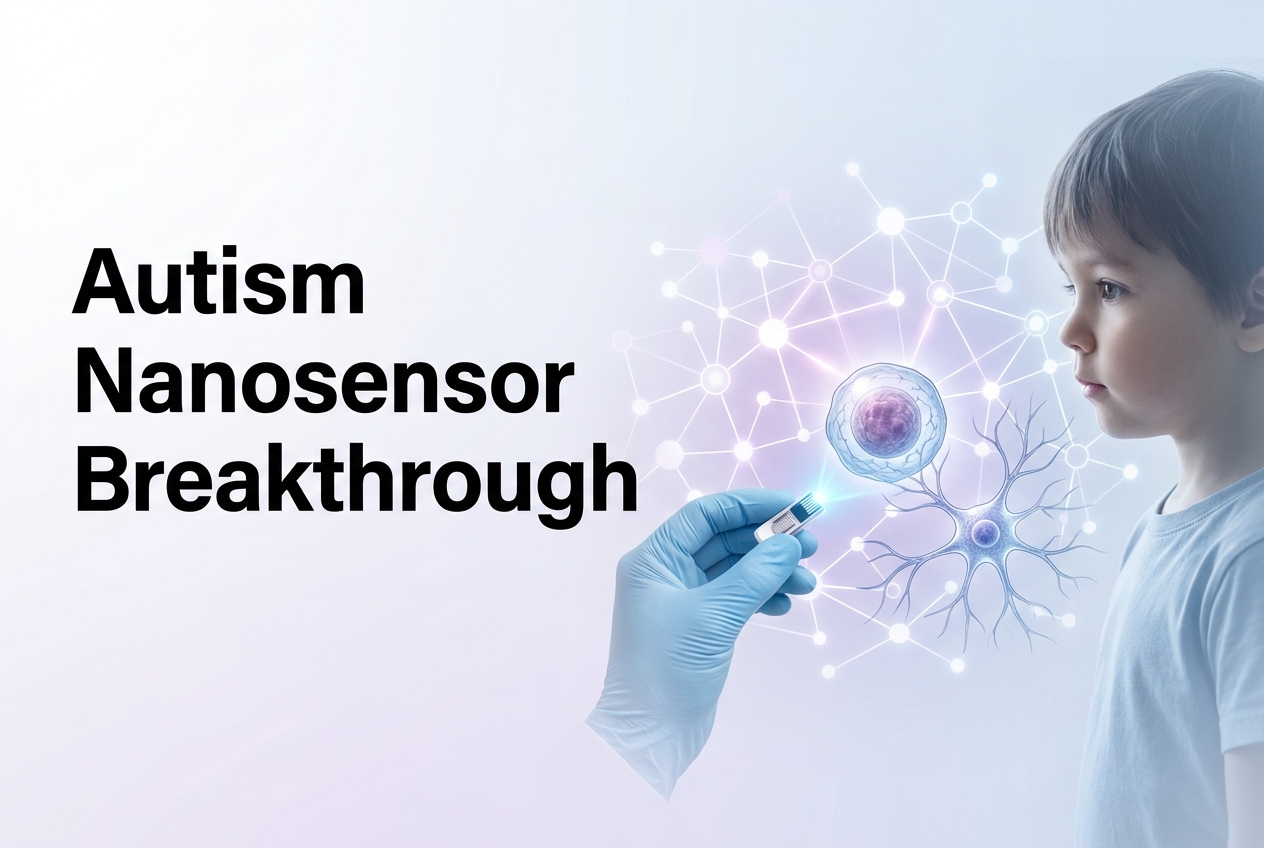
Autism has always been one of the most challenging conditions to diagnose early. Parents often wait years for clarity, navigating long evaluation processes and inconsistent screening tools. But a new study published in June 2026 introduced something genuinely groundbreaking: a nanosensor that can detect autism using a simple biochemical signal inside patient-derived stem cells. It is one of the most promising medical developments of the year, and it could reshape how autism is identified in infants.
This discovery comes from researchers at Ohio University, and it centers around measuring nitric oxide, a tiny molecule produced inside cells. What makes this so exciting is that the nanosensor can distinguish autism from other neurodevelopmental conditions with remarkable accuracy, even when the genetic differences are subtle or overlapping. For families, this could mean earlier answers, earlier support, and earlier intervention.
Below is a clear, easy to understand breakdown of what the study found, how the nanosensor works, and why this matters for the future of autism diagnosis.
What the Researchers Discovered
The study measured nitric oxide levels in induced pluripotent stem cells, often called iPSCs. These are cells that can be created from a simple sample of skin or blood and then reprogrammed to behave like early developmental cells. Because they reflect the earliest stages of human development, they are ideal for studying conditions like autism.
The researchers used a carbon fiber nanosensor to measure nitric oxide production in real time. What they found was striking:
- Autism spectrum disorder cells produced about 6 nM of nitric oxide
- Intellectual disability cells produced about 11 nM
- Neurotypical cells produced about 65 nM
These numbers show a clear separation between the three groups. Even though autism and intellectual disability can share genetic mutations and symptoms, their nitric oxide production levels were consistently different.
This is important because autism is currently diagnosed through behavioral observation. That means clinicians watch how a child communicates, plays, and interacts. While these evaluations are helpful, they often cannot be done reliably until a child is at least 18 to 24 months old. Some children are not diagnosed until age 4 or later.
A biochemical test could change that timeline dramatically.
Why Nitric Oxide Matters
Nitric oxide is a signaling molecule that helps cells communicate. It plays a role in brain development, blood flow, and immune function. Because it is involved in so many processes, it can act as a window into how cells behave at a fundamental level.
The nanosensor used in the study was originally developed for cardiovascular and Alzheimer research. It is extremely sensitive and can detect nitric oxide levels in real time. When the researchers applied it to stem cells from autism patients, they discovered that nitric oxide production was consistently lower than in neurotypical cells.
This difference was large enough that the nanosensor could reliably distinguish autism from other conditions.
How the Nanosensor Works
The nanosensor is made from carbon fiber and is small enough to measure nitric oxide inside individual cells. It works by detecting the electrical signals produced when nitric oxide interacts with the sensor surface. These signals are then converted into measurable data.
One of the most surprising findings was that the researchers did not need to turn the stem cells into neurons first. They could measure nitric oxide in undifferentiated iPSCs. This makes the process simpler, faster, and more accessible.
Another advantage is that this method bypasses the blood brain barrier. Many attempts to find autism biomarkers in blood have failed because blood does not always reflect what is happening in the brain. By using stem cells derived from the patient, the nanosensor can measure nitric oxide directly in cells that represent early brain development.
Why This Could Transform Autism Diagnosis
Early diagnosis is one of the most important factors in improving outcomes for children with autism. The earlier a child receives support, the better their long term developmental trajectory tends to be.
This nanosensor based method could allow diagnosis within the first few months of life. Instead of waiting for behavioral signs to appear, clinicians could use a small sample of somatic cells to generate iPSCs and measure nitric oxide levels.
This approach also avoids many confounding factors. Because iPSCs represent early development, they are not influenced by age, diet, medications, or environmental exposures. That makes the test more reliable and consistent.
While the study is still early and sample sizes were limited, the results are strong enough to suggest that nitric oxide could become a powerful biomarker for autism.
What This Means for Families
If this technology continues to advance, families could benefit in several ways:
Earlier clarity
Parents would not need to wait years for a diagnosis. A biochemical test could provide answers much sooner.
More accurate differentiation
Autism and intellectual disability can look similar in early childhood. This nanosensor could help clinicians distinguish between them with greater accuracy.
Better planning
Early diagnosis allows families to start therapies, support programs, and educational planning sooner.
Reduced stress
The uncertainty around autism diagnosis can be emotionally difficult. A reliable test could reduce that burden.
What Comes Next
The study opens the door to a new generation of diagnostic tools. Researchers will need to test the nanosensor on larger and more diverse populations. They will also need to determine how nitric oxide levels vary across different genetic backgrounds and environmental conditions.
If future studies confirm these findings, the nanosensor could become part of routine newborn screening. It could also help researchers understand the biological roots of autism more clearly, potentially leading to new treatments.
For now, the discovery represents a major step forward in autism research. It shows that biochemical signals inside stem cells can reveal important differences between neurodevelopmental conditions, and it provides a promising path toward earlier and more accurate diagnosis.
Better Treatment, Lower Cost – No Catch.
Find safer, more effective medications with fewer side effects – often for less money. It’s fast, free, and personalized. Learn More →
Sources (3)
- ScienceDirect Nanosensor-based method for autism diagnosis using nitric oxide from patient-derived induced pluripotent stem cells as a biomarker
https://www.sciencedirect.com/science/article/pii/S2950588726000145 - EurekAlert press release:
https://www.eurekalert.org/news-releases/1069458 - News-Medical summary and analysis:
https://www.news-medical.net/news/20260630/New-diagnostic-tool-bypasses-blood-brain-barrier-to-detect-autism-early.aspx