




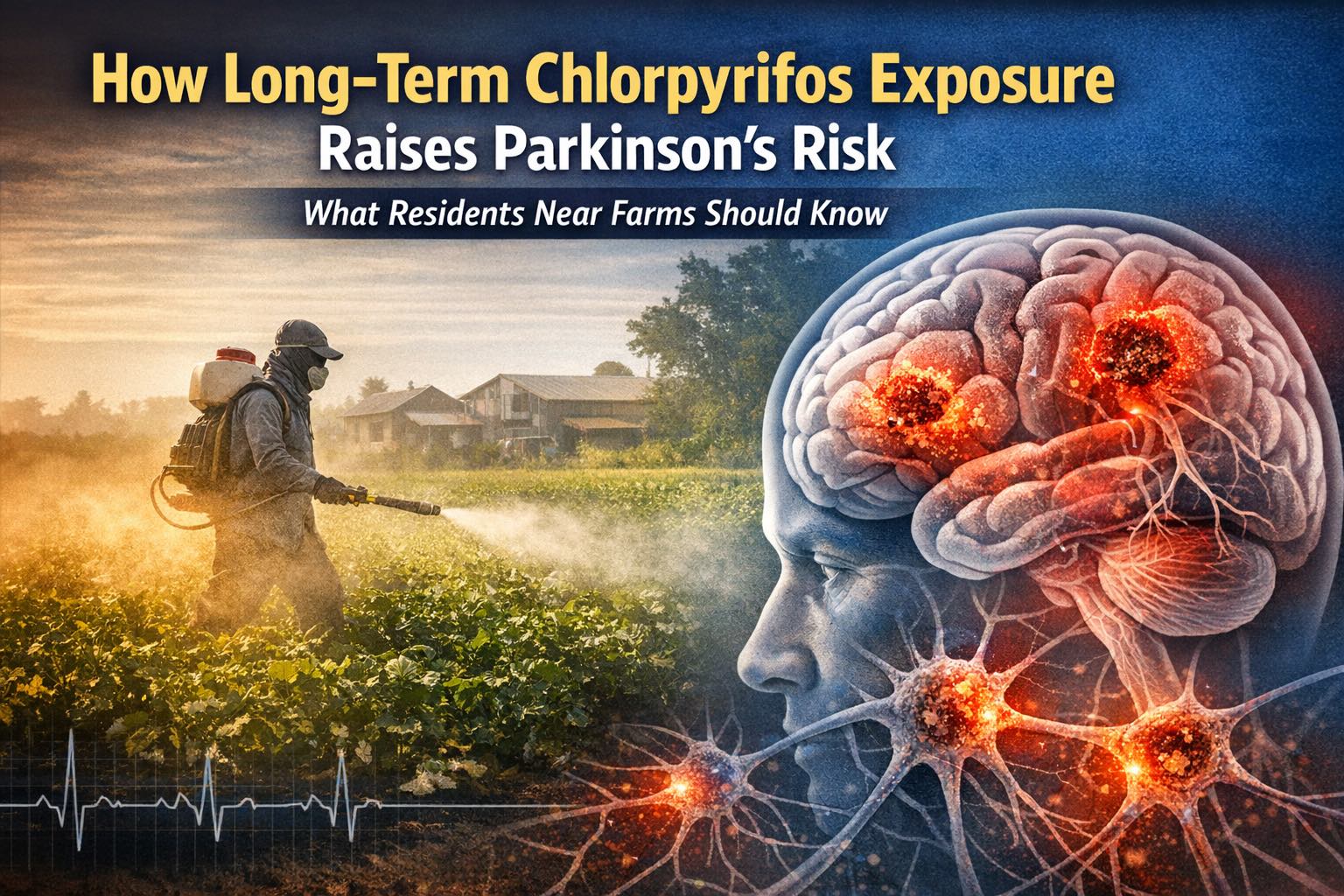
Researchers found that people who lived or worked near sustained chlorpyrifos use had over 2.5 times the risk of developing Parkinson’s disease compared with those with little or no exposure. Lab work in mice and zebrafish also showed movement problems, loss of dopamine neurons, brain inflammation, and buildup of alpha‑synuclein – the same hallmarks seen in Parkinson’s. Restoring the cell “cleanup” process (autophagy) reduced damage in models.
What this means
- Exposure doesn’t guarantee disease. This is a strong association with biological support, not a guaranteed cause for any one person.
- Risk rises with longer exposure. The study used decades of address histories and California pesticide‑use records to estimate long‑term residential exposure.
- Chlorpyrifos history. It’s an organophosphate insecticide used widely in agriculture for decades; indoor residential uses were banned in 2001 and agricultural uses have been increasingly restricted.
Practical steps you can take to reduce risk
- Limit drift exposure: Keep windows closed during nearby spraying, run HEPA air filters, and dry‑clean or wash outdoor work clothes separately.
- Lower dietary exposure: Wash produce thoroughly; choose organic for high‑residue items when possible.
- If you work in agriculture: Use PPE, follow re‑entry intervals, and insist on employer safety training and monitoring.
Quick evidence snapshot
| Evidence | What it shows | Why it matters |
| Human study (UCLA PEG cohort) | >2.5× Parkinson’s risk with long‑term residential exposure | Strong population link using pesticide records and addresses. |
| Mouse inhalation experiments | Motor deficits; dopamine neuron loss; inflammation | Shows plausible route and outcome from breathing exposure. |
| Zebrafish/cell work | Autophagy failure; alpha‑synuclein buildup | Explains mechanism of neuron damage. |
| Regulatory context | Residential ban (2001); agricultural restrictions and reviews | Policy reflects long‑standing safety concerns. |
What researchers recommend next
- Replicate the findings in other regions and populations.
- Study related pesticides to see if similar risks exist.
- Explore protective strategies that boost autophagy or prevent alpha‑synuclein buildup as possible interventions.
Better Treatment, Lower Cost – No Catch.
Find safer, more effective medications with fewer side effects – often for less money. It’s fast, free, and personalized. Learn More →
Source
UCLA Health – Widely used pesticide linked to more than doubled Parkinson’s risk.
https://newsroom.ucla.edu/releases/widely-used-pesticide-linked-to-more-than-doubled-parkinsons-risk