




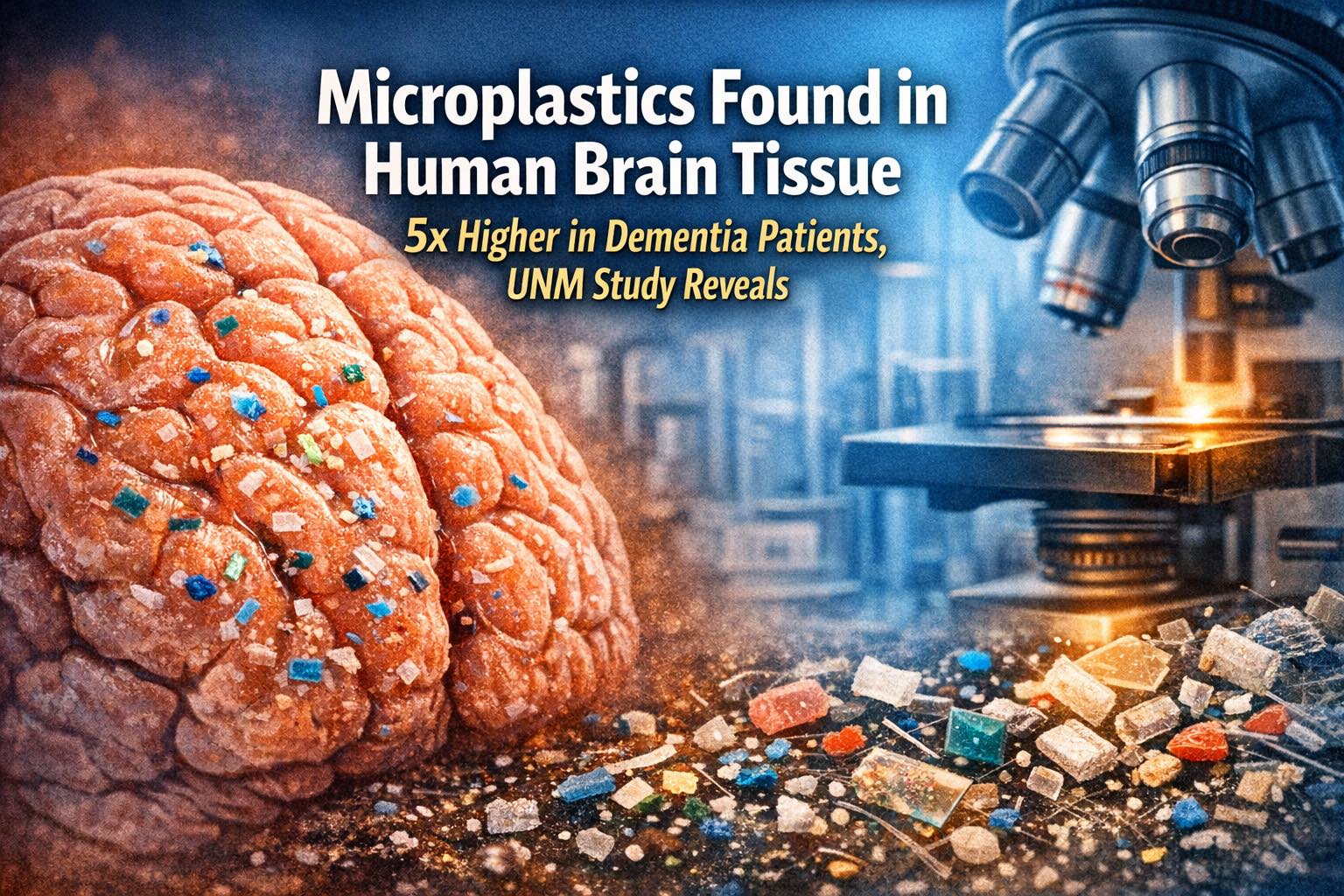
Tiny fragments of plastic are everywhere – in the air we breathe, the water we drink, and the food we eat. But a groundbreaking study led by University of New Mexico toxicology professor Matthew Campen has found something far more alarming: microplastics are accumulating inside the human brain, and levels are five times higher in people with dementia.
The research, published in Nature Medicine and reported by the University of New Mexico Health Sciences Center, marks one of the first times scientists have directly measured plastic particles in human brain tissue. The findings raise urgent questions about how these particles enter the brain, what they do once they’re there, and whether they could be contributing to neurodegenerative diseases like Alzheimer’s.
How Microplastics End Up in the Brain
Microplastics are tiny pieces of plastic less than 5 millimeters wide – often much smaller, down to the size of viruses. They form when larger plastics break down over time through exposure to heat, sunlight, and friction. These particles are now found in nearly every corner of the planet, from ocean water to soil to the food chain.
According to Campen, most microplastics enter the body through food and water. They can also be inhaled from the air. Once inside, they may travel through the bloodstream and lodge in organs. The brain, which is protected by the blood-brain barrier, was once thought to be safe from such contamination. But Campen’s team discovered that nanoplastics – particles smaller than 200 nanometers – are small enough to cross that barrier.
What the Study Found
Campen’s team analyzed brain tissue samples collected by the New Mexico Office of the Medical Investigator. The samples came from autopsies conducted between 2016 and 2024. Using advanced chemical and imaging techniques, the researchers dissolved the tissue, isolated plastic fragments, and identified them using mass spectrometry and electron microscopy.
They found:
- Microplastics in every brain sample tested.
- Concentrations in the brain were higher than in other organs such as the liver or kidneys.
- Levels of plastic increased by 50% over the past eight years.
- Dementia patients had up to 5-10 times more plastic particles in their brains compared to those without dementia.
The most common polymer detected was polyethylene – the same plastic used in bottles, packaging, and food containers. Other types included polypropylene and PVC.
Why Dementia Patients Show Higher Levels
The study found that people diagnosed with dementia had significantly more microplastics in their brain tissue. While the research doesn’t prove that plastics cause dementia, it does show a strong correlation.
Campen suggests several possible explanations:
- Dementia may weaken the blood-brain barrier, allowing more particles to enter.
- Microplastics could interfere with blood flow in tiny capillaries.
- They might disrupt communication between neurons or trigger inflammation.
- Plastic fragments could act as “seeds” for protein clumping – a hallmark of Alzheimer’s disease.
Campen cautions that more research is needed to determine whether microplastics are a cause or a consequence of dementia. But the sheer amount found in the brain is enough to raise concern.
The Bigger Picture: Plastic Pollution and Human Health
Plastic production continues to rise worldwide, and even if it stopped today, existing plastics would keep breaking down for decades. That means microplastic concentrations in the environment – and in our bodies – will continue to grow.
Campen’s research adds to a growing body of evidence showing that microplastics are not just an environmental issue but a human health threat. Previous studies have found microplastics in the placenta, lungs, liver, and even blood. The discovery of these particles in the brain suggests they can reach every part of the body.
What This Means for Everyday Life
While scientists are still learning how microplastics affect health, the findings point to a need for caution and awareness. Here are practical steps individuals can take to reduce exposure:
- Avoid heating food in plastic containers. Heat accelerates plastic breakdown.
- Use glass or stainless steel bottles instead of plastic.
- Limit consumption of processed foods and bottled drinks.
- Support policies that reduce plastic waste and improve recycling.
Campen emphasizes that the problem is systemic. “Even if we stopped producing plastic today, the particles already in the environment will keep breaking down and entering our bodies for decades,” he said. “It’s a ticking time bomb.”
Why This Research Matters
The discovery of microplastics in the brain changes how scientists think about pollution. It’s no longer just about oceans and wildlife – it’s about us. The study’s findings suggest that environmental contamination may be directly linked to neurological health.
Campen hopes the research will motivate both policymakers and the public to take plastic pollution seriously. “I have yet to meet anyone who says they’re comfortable with plastic in their brain,” he said. “This makes the issue personal.”
Key Takeaways
| Finding | Details |
| Microplastics found in human brain tissue | First direct evidence from UNM study |
| Dementia patients | 5-10x higher plastic levels |
| Most common plastic | Polyethylene (used in bottles and packaging) |
| Trend over time | 50% increase in brain plastic accumulation since 2016 |
| Possible effects | Inflammation, disrupted blood flow, protein clumping |
| Main exposure routes | Food, water, air, and plastic packaging |
The Path Forward
Campen’s team plans to continue studying how microplastics interact with brain cells and whether they contribute to neurodegenerative diseases. They also aim to explore how different types of plastics behave in the body and whether certain materials are more harmful than others.
For now, the message is clear: plastic pollution isn’t just an environmental problem – it’s a human one. And the brain, our most vital organ, may be paying the price.
Better Treatment, Lower Cost – No Catch.
Find safer, more effective medications with fewer side effects – often for less money. It’s fast, free, and personalized. Learn More →
Sources (5)
- UNM Researchers Find Alarmingly High Levels of Microplastics in Human Brains – University of New Mexico Health Sciences Center
https://hscnews.unm.edu/news/hsc-newsroom-post-microplastics-human-brains - Tiny Plastics, Big Questions: In Conversation with Dr. Matthew Campen – National Institute of Environmental Health Sciences
https://www.niehs.nih.gov/news/factor/2025/4/feature/matthew-campen-tackles-microplastics-and-nanoplastics - Making Sense of Microplastics: New Research Looks at How Microplastics Build Up in the Brain and Body – Alzheimer’s Disease Research Center
- Nature Medicine – Bioaccumulation of Microplastics in Decedent Human Brains (Matthew Campen et al., 2025)
- University of New Mexico College of Pharmacy – Faculty Profile: Matthew Campen, PhD