




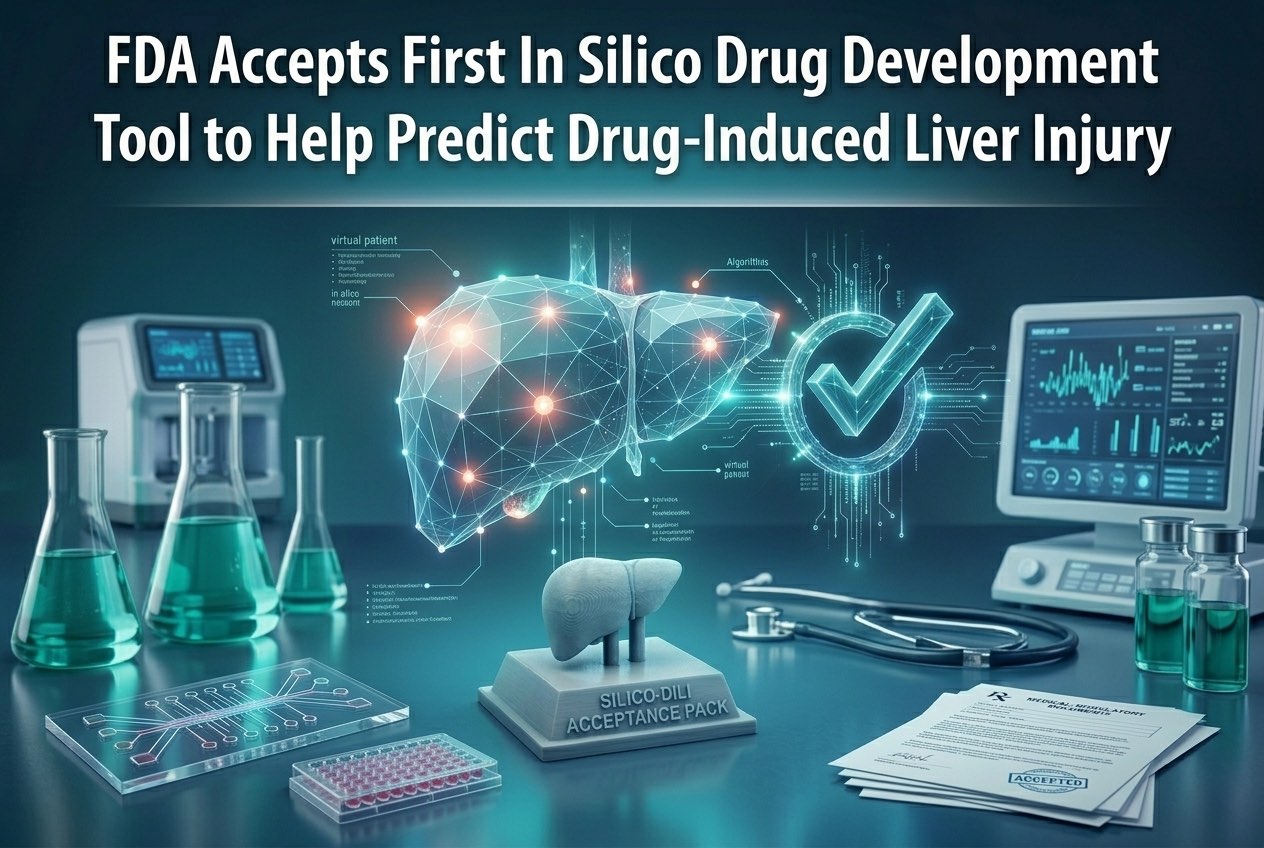
The U.S. Food and Drug Administration has taken an important step toward modernizing how new medicines are evaluated before they ever reach human testing. In early June 2026, the agency announced that it accepted the first Letter of Intent for an in silico, or computer‑based, drug development tool designed to help predict drug‑induced liver injury. This marks the first time such a digital model has entered the FDA’s ISTAND Program, a pathway created to evaluate innovative scientific tools that fall outside traditional drug development methods.
Drug‑induced liver injury, often shortened to DILI, is one of the biggest reasons drug candidates fail during development. It can cause clinical trials to stop early and can even prevent promising treatments from ever reaching patients. Because of this, researchers and regulators have long looked for better ways to predict liver toxicity before a drug is tested in people. The newly accepted tool aims to help fill that gap by using artificial intelligence to compare the chemical structure of a new drug with drugs already known to cause liver problems.
This development is part of a broader shift in the pharmaceutical world toward using advanced computer models, artificial intelligence, and other digital technologies to improve safety predictions. It also reflects the FDA’s ongoing interest in reducing reliance on animal testing and speeding up the development of safe, effective treatments.
What the FDA Accepted and Why It Matters
The tool accepted into the ISTAND Program is an AI‑driven digital liver model. In simple terms, it is a computer simulation of how the human liver might react to a new drug. Instead of relying only on lab experiments or animal studies, the model uses patterns learned from existing drugs with known liver risks. By comparing chemical structures, the model attempts to estimate whether a new drug might cause similar problems.
This matters because predicting liver injury is notoriously difficult. Even drugs that look safe in early testing can cause unexpected liver problems once they reach human trials. The FDA notes that current methods do not reliably predict human risk, which is why DILI remains a major cause of drug development failures. A tool that improves early predictions could help researchers avoid costly dead ends and focus on safer drug candidates.
The acceptance of this tool into the ISTAND Program does not mean it is fully approved for regulatory use yet. Instead, it marks the first step in a three‑stage qualification process. The developer must now submit a detailed qualification plan, followed later by a full qualification package. Only after completing all stages could the tool be officially recognized for use in regulatory submissions.
Still, being accepted into the program is a significant milestone. It signals that the FDA sees potential value in the technology and is willing to work with developers to evaluate it thoroughly.
What Is the ISTAND Program?
The ISTAND Program, short for Innovative Science and Technology Approaches for New Drugs, was created to evaluate new types of drug development tools that do not fit into existing FDA qualification programs. These tools can include digital models, artificial intelligence systems, novel laboratory methods, and other emerging technologies that could help improve drug development.
The program exists because drug development is changing rapidly. Traditional tools like animal studies, biomarkers, and clinical assessments are still important, but they are not always enough to answer complex safety questions. New technologies can offer fresh insights, but they need a clear pathway for evaluation. ISTAND provides that pathway.
Examples of tools that might be considered under ISTAND include:
- Digital health technologies that help measure patient outcomes
- Tissue chips, also known as microphysiological systems, that mimic human organs
- Artificial intelligence algorithms that help design studies or evaluate patient data
- Novel laboratory assays that improve understanding of drug effects
By accepting the digital liver model into ISTAND, the FDA is signaling that computer‑based safety prediction tools are becoming an important part of the future of drug development.
How the Digital Liver Model Works
While the underlying technology is complex, the basic idea is straightforward. The model uses artificial intelligence to analyze the chemical structure of a new drug and compare it with a library of drugs that have known liver toxicity risks. If the new drug looks similar to drugs that have caused liver injury in the past, the model may flag it as higher risk.
This approach is known as an in silico method, meaning it relies on computer simulations rather than physical experiments. In silico tools are becoming more common across many scientific fields because they can analyze large amounts of data quickly and identify patterns that might not be obvious through traditional testing.
The FDA describes this digital liver model as a New Approach Methodology, or NAM. NAMs are innovative scientific methods that can reduce or replace animal testing, improve prediction accuracy, or provide new types of information that were not previously available. The digital liver model aligns with the FDA’s long‑standing interest in the 3Rs of animal testing: replacement, reduction, and refinement.
Importantly, the model is not intended to replace all other safety testing. Instead, it is meant to complement existing methods as part of a weight‑of‑evidence approach. This means researchers would consider the model’s predictions alongside laboratory tests, animal studies, and other data when evaluating a drug’s safety.
Why Predicting Liver Injury Is So Challenging
The liver is the body’s main detoxification organ, which means it processes nearly every drug a person takes. Because of this, it is also one of the organs most vulnerable to drug‑related damage. But predicting liver injury is difficult for several reasons:
- Human livers vary widely. Genetics, diet, alcohol use, and other factors can influence how a person’s liver responds to a drug.
- Animal models do not always match human biology. A drug that appears safe in animals may still cause liver problems in humans.
- Some liver injuries develop slowly. Early tests may not detect problems that only appear after longer exposure.
- Chemical structures can behave unpredictably. Small changes in a molecule can lead to big differences in how the liver processes it.
Because of these challenges, researchers are eager for better tools that can help identify risky drugs earlier in the process. The digital liver model aims to provide one more piece of the puzzle.
Potential Benefits for Patients and Drug Developers
If the digital liver model eventually completes the FDA’s qualification process, it could offer several benefits:
Earlier Identification of Risky Drugs
By flagging potential liver toxicity before human trials begin, the model could help researchers avoid investing time and resources into drugs that are unlikely to succeed. This could shorten development timelines and reduce costs.
Reduced Reliance on Animal Testing
Because the model is computer‑based, it could help reduce the number of animals needed for early safety testing. This aligns with the FDA’s interest in promoting humane and scientifically advanced alternatives.
More Informed Decision‑Making
Developers could use the model’s predictions to design better studies, adjust chemical structures, or prioritize safer drug candidates. Regulators could also use the information to support safety assessments.
Faster Access to Safe Treatments
By improving the efficiency of drug development, tools like this could help bring safe, effective treatments to patients more quickly.
What Happens Next
Acceptance into the ISTAND Program is only the beginning. The developer of the digital liver model must now submit a qualification plan that outlines how the tool will be evaluated. After that, a full qualification package must be submitted with detailed evidence supporting the tool’s performance. Only after completing all three stages could the tool be officially qualified for regulatory use.
Even so, the FDA’s decision to accept the tool into the program is a strong sign that digital models and artificial intelligence will play an increasingly important role in the future of drug development. As technology continues to advance, tools like this could help make the process safer, faster, and more efficient.
The FDA’s acceptance of the first in silico drug development tool under the ISTAND Program represents a meaningful step forward in modernizing how new medicines are evaluated. By embracing artificial intelligence and digital modeling, the agency is opening the door to more innovative, humane, and efficient approaches to drug safety assessment.
Drug‑induced liver injury remains a major challenge in drug development, but tools like the AI‑driven digital liver model offer new hope for predicting risks earlier and more accurately. While the tool still has a long way to go before full qualification, its acceptance into the ISTAND Program signals a promising future for digital technologies in medicine.
Better Treatment, Lower Cost – No Catch.
Find safer, more effective medications with fewer side effects – often for less money. It’s fast, free, and personalized. Learn More →
Sources (2)
- FDA – Innovative Science and Technology Approaches for New Drugs (ISTAND) Program
https://www.fda.gov/drugs/drug-alerts-and-statements/fda-accepts-first-silico-drug-development-tool-under-istand-program-help-predict-drug-induced-liver - Becker’s Hospital Review – FDA accepts letter of intent for 1st AI drug development tool
https://www.beckershospitalreview.com/healthcare-information-technology/fda-accepts-letter-of-intent-for-1st-ai-drug-development-tool.html